
Last Updated on 28 de junho de 2022 by Wine Fun
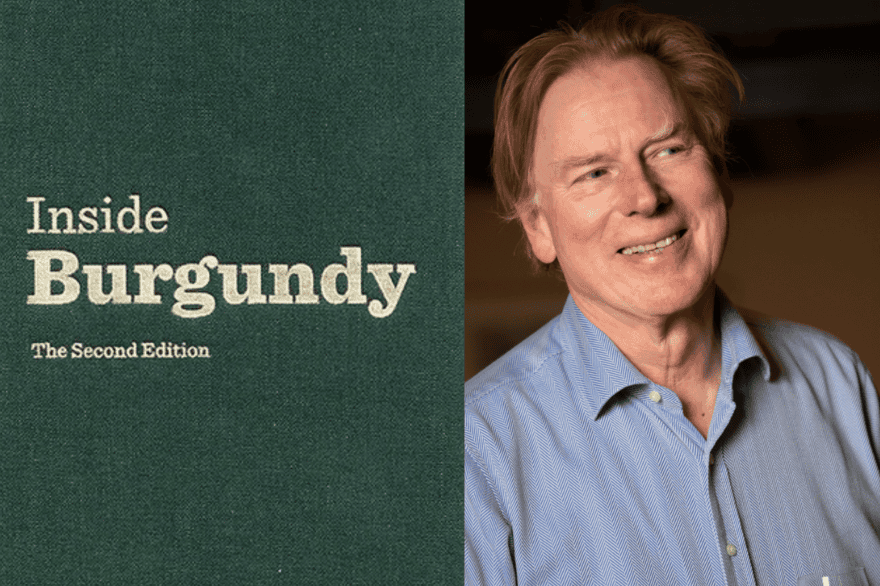
Jasper Morris needs no introductions. This very empathic English Master of Wine is recognized by many people as the greatest wine expert in Burgundy today. His prestige doesn’t respect borders. When I bought the latest edition of his book Inside Burgundy at the main bookshop in Beaune, the wine capital of Burgundy, I received the best definition from the cashier. “Have you decided to buy the Burgundy Wine Bible?” asked the Frenchman. This is something that could be hard to imagine, considering so many centuries of rivalry between France and Britain. Morris has lived in Burgundy for many years, more specifically in a small village near Beaune.
Over the years he has developed a close relationship, but always professional, with many producers. And that’s an inexhaustible source of information. In addition to his books, he is also responsible for the Jasper Morris Inside Burgundy website, where he publishes constant updates on wines and producers.
Wine Fun (WF): The expression “Burgundy is now at its best” has been used very often in the last few years. Do you believe this represents the truth, especially considering the impact of global warming?
Jasper Morris (JM): In the past, Burgundy was a marginal zone. Perfect vintages sometimes, but many times quite tricky to achieve ripeness. Now it is the other way round. Things have changed. But also, the tastes may change. Maybe new generations of wine drinkers will be accustomed to different flavour profiles and will be perfectly happy with Pinot Noir at 14 plus alcohol and very rich fruit. But this is not what I and others are looking for. Chardonnay, however, is more flexible. We can find great Chardonnay from 11% to 15,5% worldwide; it doesn’t matter that much.
As for global warming, however, we should have a broader view. We are fixated on the vines, but many trees are dying from drought and bugs, looking at the last three years in Burgundy. And bees are also disappearing; where I live, almost the whole village lost their beehives.
WF: As we discuss the impact on different grapes, Aligoté seems to be recovering ground in Burgundy as a more acidic and fresher grape than Chardonnay. How do you see this trend?
JM: We now see Aligoté being planted on a range of single vineyards, but not in grand terroirs; generally, there are only generic Burgundies. Nonetheless, this grape shows apparent differences, depending on where it is planted, as much as Chardonnay. We should never forget that Corton-Charlemagne was planted with Aligoté in the XIX century. There are now talks of allowing a percentage of Aligoté, at least on Village wines. I see no problem at all in introducing Aligoté alongside Chardonnay, and eventually, one day, it may become the main grape in the region. But nothing similar is possible in the case of reds, as replacing Pinot Noir should mean the end of Burgundy as a top producer of red wines.
WF: Organic and biodynamic farming is also gaining ground in Burgundy. Do you see this part as a response to global warming?
JM: Hot and warm climates are easier for organics than wet ones, but volatile and extreme weather conditions, on the other way, make it more difficult. The organic movement passed the tipping point, accepted especially by the younger generation. But there is a clear need for certification. Biodynamics is more a philosophy; organic, however, is fundamental but not necessarily only a good thing. Let’s keep in mind that some organic products may be more toxic than chemical products, and to be organic, the producer must spray a lot more often, with a higher carbon footprint. But I am keen, especially if the all-region swings over, getting real traction.
WF: Winemaking in the region also seems to be moving toward lower intervention, even if the region has always been known for less intervention in the cellar.
JM: Most producers had no money to buy the “new” technology in the past. I remember Frederic Mugnier saying: “20 years ago, we had lots of wine but no money. Now we have all the money we ever imagined, but not enough wine”. Looking at the present, very few people are making bad wines, though you may not like the style; some are too experimental, allowing deviations and trying to push boundaries. In the past, it was different. When I started forty years ago, many people were consistently doing bad wine, some that tasted like the time of their parents or grandparents.
In the past, many producers used extraction and wood in excess. Now it is different, but not necessarily only a change in style. The fact is that grapes are riper, tannins less aggressive now. The wines are more accessible earlier, but true greatness only appears when adequately matured. The main question for today’s wines is simple: would the wines still be good when they are old?
The saving grace for Burgundy is that the region didn’t take the same path at the same time as happened in Bordeaux, where almost everybody followed Robert Parker. In Burgundy, you had a school in Gevrey-Chambertin going for new oak, darker colour, and more extraction. But others, like Rousseau, did not follow.
We may call that “modern winemaking”: cold soak, a fair proportion of new oak, reasonably extraction, deep colour, pure fruit. If it works well, fine; otherwise, it looks like producers are following a recipe. Now people like Charles Lachaux are throwing it all out, using short maceration, whole-bunch, no new oak. His wines are sublime, reflecting great plots and arduous work in the vineyards.
WF: May we say that winemaking in Burgundy has a new trend, defined as less oak, more whole-bunch, less extraction and early picking?
JM: This combination is one of the trends attracting attention and certainly a good one. However, there is a “countertrend” that states that it is essential to wait for phenolic ripeness. But the weather has changed; you can’t do it anymore and need to accept the compromise. For example, in 2020, we saw a few ugly beasts with 14,5-15% in alcohol and a flavour profile heading towards cooked fruit. Unfortunately, once the wine has cooked flavours, it never comes back. On the other hand, underripe grapes are not perfect, but later in the bottle, you get somewhere.
WF: One big issue in Burgundy is the classification system and the eternal discussions about which climats should be classified as Premier Cru or Grand Cru. For example, a few Premier Cru are already being sold with Grand Cru status.
JM: The obvious two Premier Cru that could become Grand Cru, as they already sell like Grand Cru, are Le Clos Saint-Jacques and Les Amoureuses. In addition, there are 3-4 Premiers Crus in Vosne-Romanée (Malconsort and Petit Monts, amongst them). On the other hand, many villages without a Grand Cru are looking for one. One example is Nuits Saint-Georges, with Les Saint-Georges, but there are also candidates in the northern part, such as Aux Boudots and Aux Murgers, which are at least as good, although with a different style.
Pommard Les Rugiens is another candidate, but I think it will not happen, as there is a substantial difference between its lower and higher sections. Others that may not succeed are Les Epenots or Volnay Caillerets (the best in Volnay, but I don’t think it has the extra thing). In whites, Meursault Perriéres is the closest to it. But one thing is crucial: there is no real need to change, as prices already reflect it.
However, if I change things, I will remove a lot of Grand Cru. One example: what they should have done is to make Corton Clos du Roi, and maybe Les Bressandes or Renardes, as Grands Crus, not most of the hill. All the other Corton sell at mid-range Premier Cru price, not Grand Cru.
Regarding Premier Cru, Beaune is spoiled for having too many (maybe keep Les Grèves, Les Vignes Franches, Le Clos des Mouches, and some other mid-slope vineyards). The same thing in the Côte Chalonnaise. Premier Cru needs to be more unique.
WF: And what are the appellations still offering good value in Burgundy?
JM: As for villages with good value, we should consider Monthelie, Auxey-Duresses, and Saint Romain, especially in the cooler areas. There are also exciting plots in the Hautes Côtes, not to mention the potential to make great wines in the Mâconnais. Chablis still offers excellent value for Premier Cru, but I am worried if vintages like 2018/19/20 become standard.